When your due date nears…or has come and gone…you may start paying closer attention to the cues your body is giving you.
Maybe your baby has dropped further into your pelvis.
Maybe you’ve lost your mucus plug.
Maybe you’re feeling contractions and wondering: is this it?
The first stage of labor can feel like a lot to process. Understanding what’s happening in your body can help you feel more grounded as things begin to shift.
The first stage of labor is broken down into three phases:

infographic - first stage of labor
Understanding Pre-Labor: Braxton Hicks vs. Prodromal Labor
Braxton Hicks Contractions
Braxton Hicks contractions are preliminary contractions that can be experienced as early as 20 weeks, but more commonly in the third trimester.
These contractions:
feel like a tightening of the abdomen
are typically not painful
are short, and irregular
do not become progressively stronger
They often ease with:
hydration
rest / movement
changing positions
Late in pregnancy, Braxton Hicks contractions can be a sign your body is preparing. They may also be your body’s way of asking you to slow down.
Prodromal Labor
Prodromal labor can feel more confusing. This is a variation of normal labor progression where early labor starts and stops over long periods of time, sometimes days.
Prodromal labor contractions:
may follow a pattern
can increase in intensity
may affect the cervix (effacement and/or dilation)
often pick up at night and slow in the morning
But then… they stop.
These start-stop contraction patterns can occur right before active labor begins. Prodromal labor contractions can feel exciting at first, but when they stop, people often feel frustrated, discouraged and exhausted.
Even when they stop, your body is still working hard, preparing to meet your baby.
Signs of Early Labor (What It Actually Feels Like)
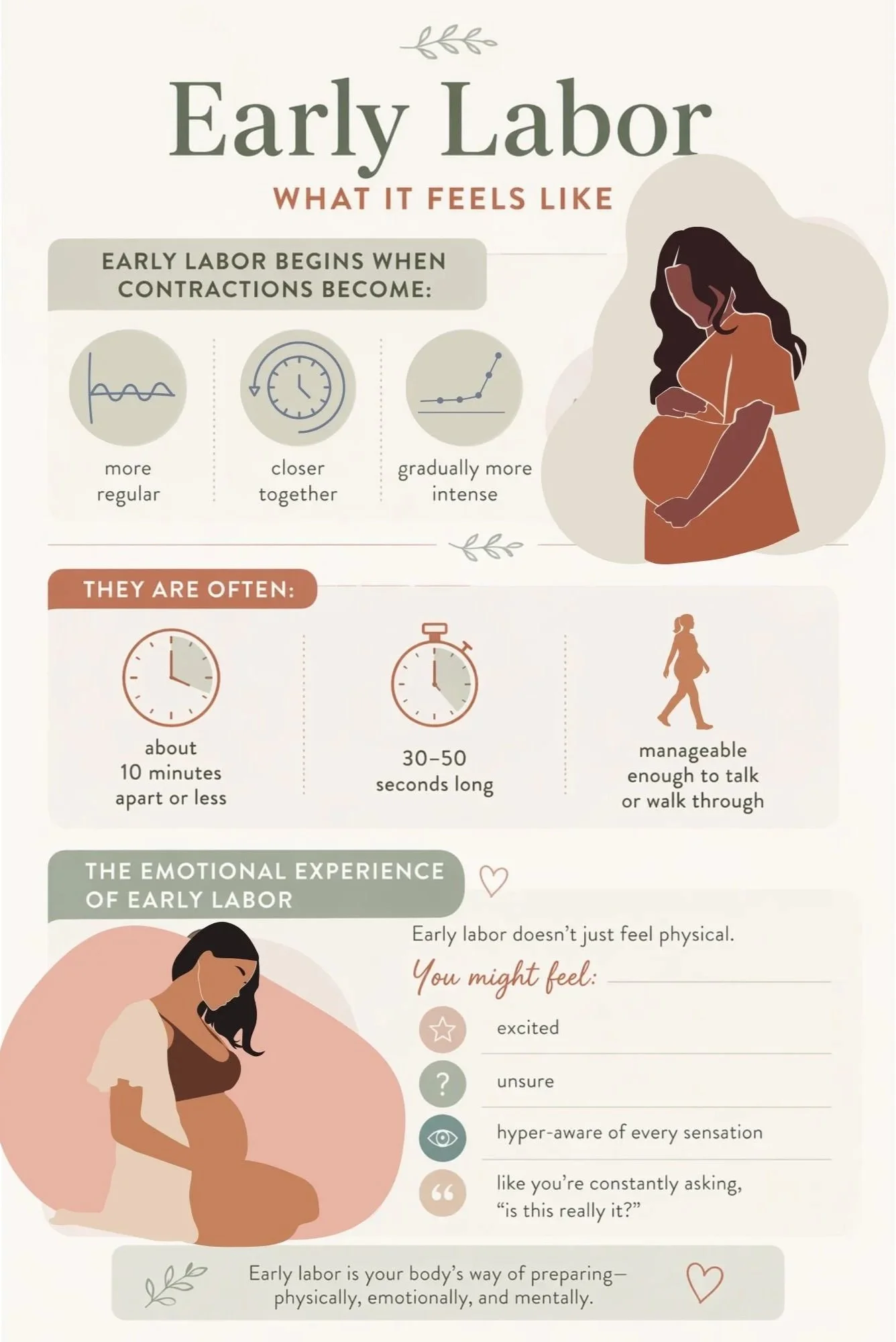
infographic - early labor
What to Do in Early Labor
This phase is often underestimated!
Early labor is the time to:
rest as much as possible
fuel your body with food
hydrate
stay in a comfortable, familiar environment
It can be tempting to rush things along, but early labor is where many people unintentionally use up energy they will need later.
If you can, sleep!
When to Call Your Care Team
During early labor, it’s a good time to notify:
your doula
your midwife or OB
childcare or pet support if needed
Your doula may join you later in labor once things have progressed, helping reduce the likelihood of heading to your birth place too early.
A commonly used guideline is the 5-1-1 rule:
contractions 5 minutes apart
lasting 1 minute
for 1 hour continuously
This tells us that your contractions are strong enough, long enough and close enough together to make cervical change, and it may be a good time to head to the hospital.
Active Labor: The Shift
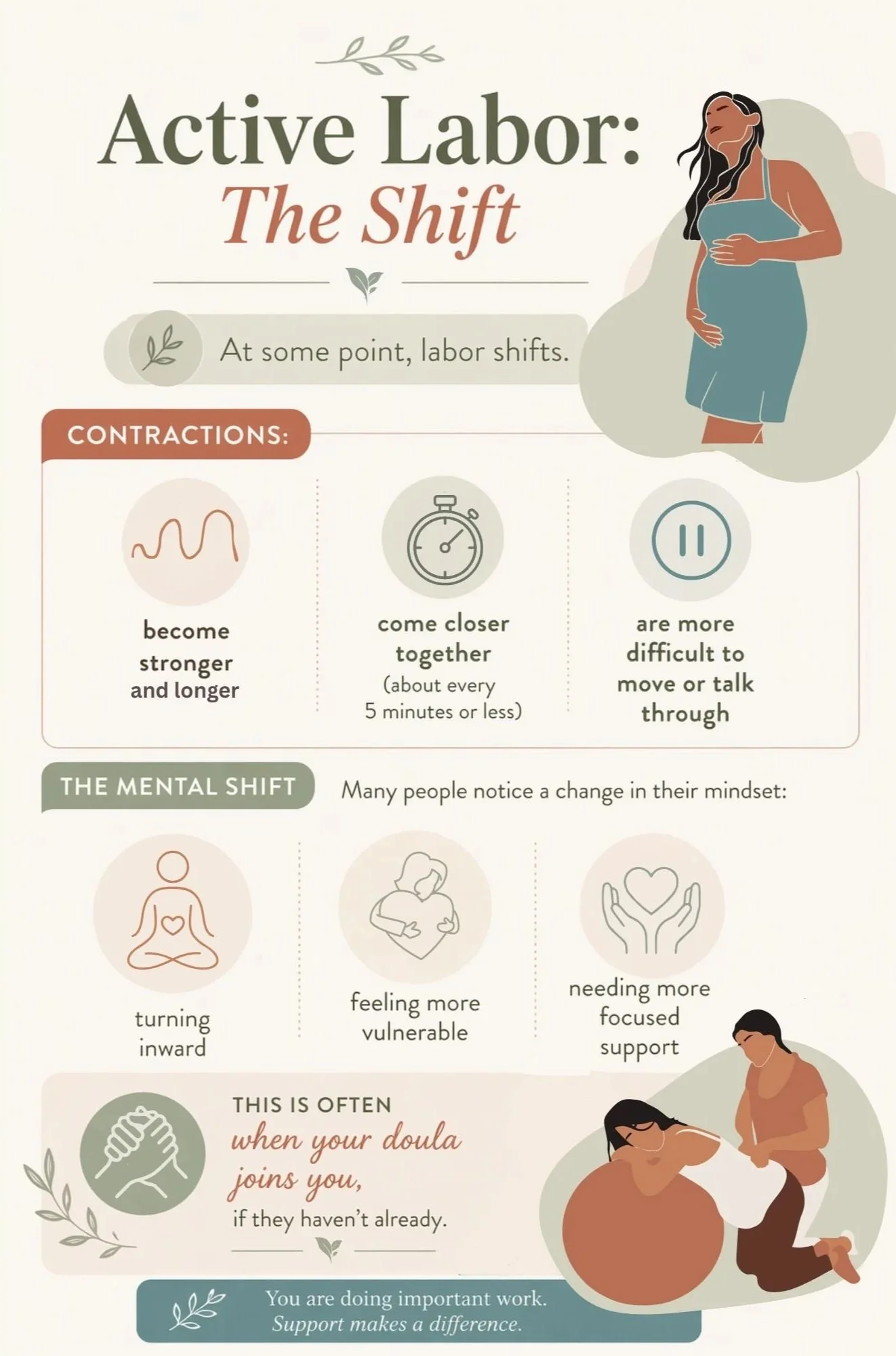
infographic - active labor
How Long Does Active Labor Last?
Active labor often lasts 4–8 hours, though it can be longer, especially for first births.
There is a wide range of normal.
During this phase, some people choose interventions such as an epidural, while others continue using movement, breathing, and support to cope with contractions.
Transition: The Most Intense Phase
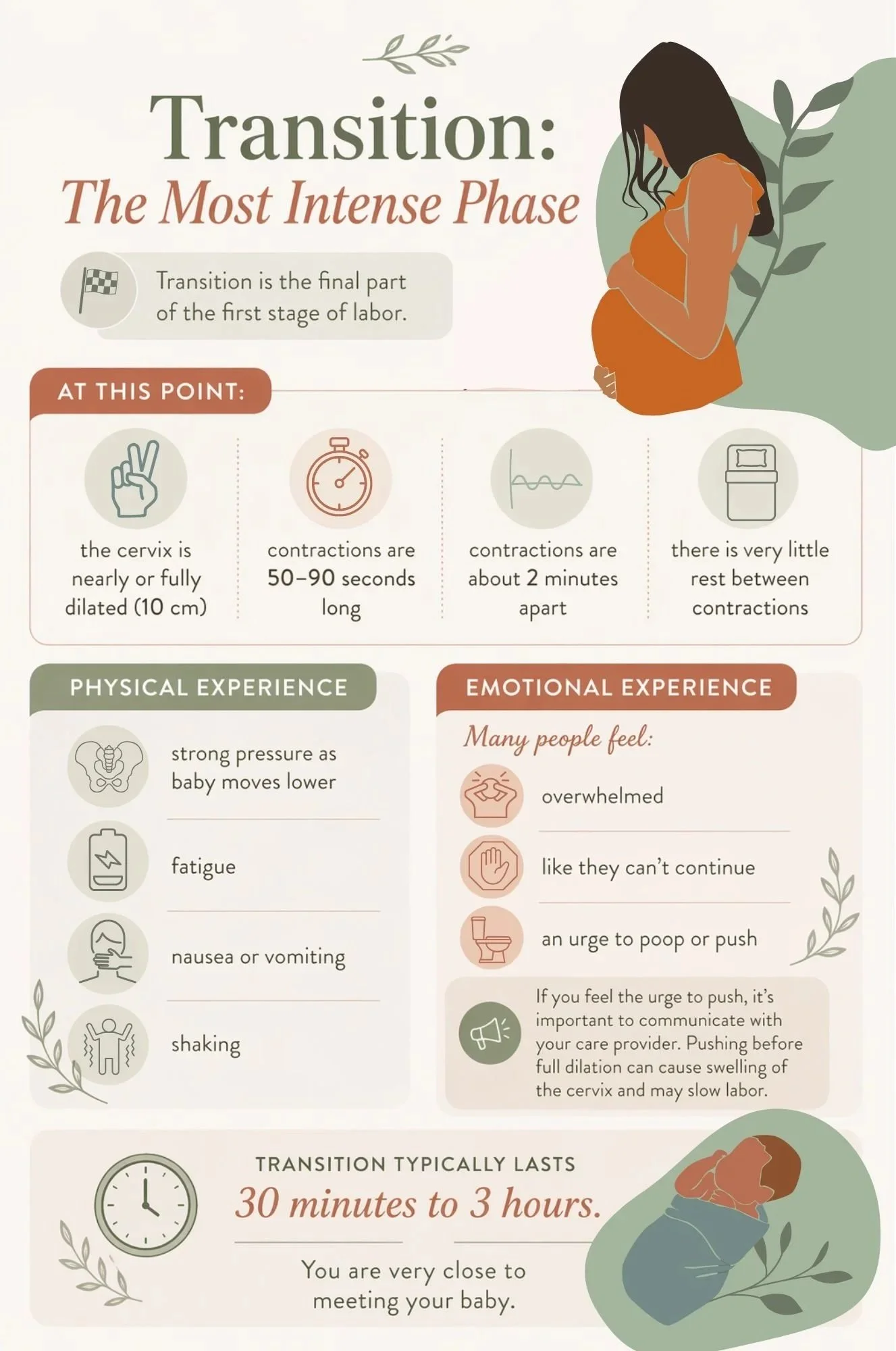
infographic - transition phase of labor
How to Time Contractions
As contractions progress, timing them can help you understand patterns.
Time from:
the start to end of one contraction - this measures duration
to the start of one contraction to the start of the next contraction - this measures how far apart they are.

timing contractions in early labor
Signs That Labor May Be Starting
Mucus Plug
The mucus plug protects the cervix and uterus during pregnancy.
Losing it can mean:
cervical change is happening
your body is preparing for labor
However:
it can happen weeks before labor begins
or during labor
It is not a reliable indicator that labor is close. The mucus plug regenerates, so you may continue to lose it over time.
Water Breaking
Water breaking doesn’t always happen as a dramatic gush.
It may be:
a slow trickle
intermittent leaking
If your water breaks, take note of:
color
odor
amount
time
This helps your care provider guide next steps. Your water can break with or without onset of labor.
Understanding What Your Body Is Doing
Labor involves several coordinated changes:
Effacement (Thinning)
The cervix thins from 0% to 100%.
Dilation (Opening)
The cervix opens from 0 to 10 cm.
Cervical Position
The cervix moves from posterior (back) to anterior (front).
Fetal Station
Station describes how low baby is in the pelvis, from -5 to +5.
At 0, baby is engaged. At +5, baby is crowning.
All these changes happen gradually over time. They can start beefore labor begins, but most changes occur during labor itself.
When to Call Your Provider
Reach out to your care provider if you experience:
heavy vaginal bleeding
fever
meconium-stained fluid (dark or greenish fluid)
very rapid labor (under 5 hours, especially with sudden intense contractions)

early labor leaning on ball
What Is Precipitous Labor?
Precipitous labor is a very rapid labor, typically lasting under 5 hours from the start of regular contractions to birth.
While some may assume a fast labor is ideal, precipitous labor can feel intense, overwhelming, and sometimes disorienting for the birthing person.
What It Can Feel Like
contractions become strong very quickly
little time between contractions from the beginning
intensity increases rapidly without a gradual build
a sudden urge to push before processing what is happening
There is often very little time to adjust physically or mentally before labor becomes intense.
Potential Considerations
Precipitous labor can be entirely physiological, but it may also be associated with:
increased risk of vaginal or cervical tears
higher likelihood of postpartum hemorrhage
feeling shocked or emotionally overwhelmed by the pace of labor
When to Call Your Provider
If your contractions:
become intense very quickly
are close together from the start
or you feel like labor is progressing rapidly
You should contact your provider or head to your birth location sooner rather than later.

first stage of labor, holding back
Final Thoughts: Moving Through the First Stage of Labor
The first stage of labor is the longest and most unpredictable, lasting hours, or even days.
You may feel:
excitement
anxiety
intensity
awe
And that is all to be expected. There are many ways to cope and move through it.
Your body is working hard.
You’ve got this!
